Nursery Admission in Kanpur 2027–28: Age Criteria, School Readiness, Documents & Complete Parent Guide: Choosing a nursery school is often the first major educational decision parents make for their child. It may look simple from the outside—find a nearby preschool, check the age criteria and complete the admission form—but most parents quickly realise that the real decision is much bigger.
Which programme is right for my child? Is my child ready for Nursery or should we consider Pre-Nursery? How much importance should we give to academics at this age? What should we look for during a preschool visit? How experienced are the teachers? How does the school handle a child who is nervous on the first few days? How much daily travel is reasonable for a three- or four-year-old?
For families planning nursery admission in Kanpur for the 2027–28 session, these questions matter much more than simply finding a school with an available seat.
The early years shape how a child begins to think about school itself. A positive preschool experience can help children become more confident, expressive, independent and curious. A stressful environment, on the other hand, can make children associate learning with pressure before formal schooling has even properly begun.
That is why parents should look beyond advertisements and “best preschool” lists. The right preschool should provide a combination of good teachers, a safe environment, developmentally appropriate learning, communication with parents, manageable travel and enough individual attention for young children.
This guide has been prepared to help parents in Kanpur understand the nursery admission process more clearly and make a thoughtful choice for the 2027–28 academic year.
What Is the Right Age for Nursery Admission?
Age is usually the first thing parents check when planning admission.
Different schools may use slightly different programme names and age cut-offs, so parents should always confirm the final eligibility criteria directly with the school for the relevant academic session.
Broadly, preschool education follows a progression such as Playgroup, Pre-Nursery, Nursery and Kindergarten.
At Candy Floss Preschool, the programme structure currently follows a progression where Playgroup begins around age two, Pre-Nursery or Lower Nursery around age three, followed by Nursery and Kindergarten as children move through the early-learning years.
But age alone should not decide whether your child is ready.
Two children of exactly the same age can have very different comfort levels, language abilities, social confidence and independence.
One child may happily walk into a classroom and immediately begin playing with other children. Another child of the same age may need several days or weeks to feel comfortable away from parents.
Both can be completely normal.
Instead of asking only, “Is my child old enough for Nursery?” parents should also ask, “Is this the right environment and programme for my child at this stage?”
Nursery Admission Age & Preschool Readiness Checker
Planning nursery admission in Kanpur? Enter your child’s date of birth and answer a few simple readiness questions to get an indicative Playgroup, Pre-Nursery or Nursery stage suggestion.
1 Check your child’s age
2 Quick preschool readiness check
Readiness snapshot
What to do next
How this nursery admission checker can help parents
Parents searching for nursery admission in Kanpur often need to understand more than an age cut-off. A child’s communication, comfort in a group, independence, curiosity and ability to follow simple routines can all influence how smoothly preschool begins.
Families comparing a preschool in Kanpur, nursery school in Kanpur or preschool in Pandu Nagar should use this result as an initial guide and then visit shortlisted schools before making a final admission decision.
Candy Floss Preschool in Pandu Nagar currently offers age-specific early-learning stages including Playgroup, Pre-Nursery / Lower Nursery, Nursery and Kindergarten.
Important: This tool provides an indicative programme and readiness suggestion only. It is not an admission decision, developmental assessment or medical evaluation. Programme names, age cut-offs and admission requirements may change for the 2027–28 academic session. Parents should confirm current eligibility directly with Candy Floss Preschool.
What Does School Readiness Actually Mean?
School readiness is sometimes misunderstood as the ability to read, write or count before joining Nursery.
That should not be the main test.
A young child does not need to enter preschool already knowing everything the preschool is supposed to help them learn.
Readiness is better understood through everyday abilities.
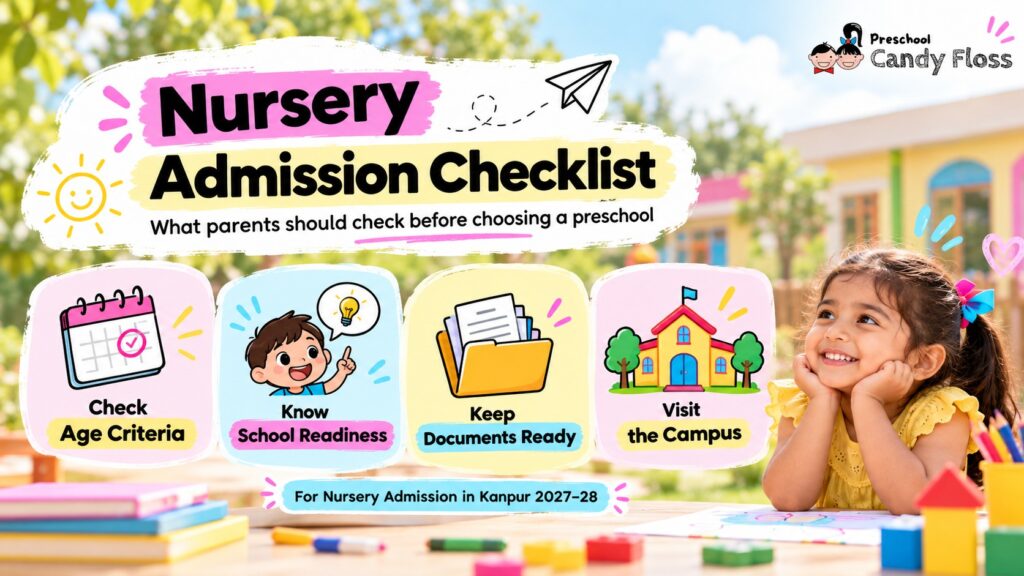
Can your child communicate basic needs?
Can they tell an adult when they are thirsty, uncomfortable or need help?
Can they follow a simple instruction such as “keep the toy back” or “bring your bottle”?
Can they remain with a trusted adult other than their parents for a short period?
Do they show curiosity about new things?
Can they participate in simple play around other children?
Are they beginning to recognise their own belongings?
Can they manage small routines with some support?
These are much more meaningful signs of readiness than whether a child can already write the alphabet.
Young children develop differently. Preschool should help children grow from where they are rather than expecting every child to arrive with the same skills.
Nursery Admission Should Not Become an Academic Competition
Parents naturally want their children to get a strong start.
But a strong start does not mean pushing formal academics too early.
Children in the preschool years are developing language, coordination, emotional regulation, social behaviour, confidence, curiosity and independence at the same time.
A child who learns to communicate confidently, listen to a story, wait for a turn, build something with blocks, ask questions and solve a simple problem is learning important things.
These skills may not look as impressive on a worksheet, but they create the foundation for future learning.
Parents should therefore be careful when comparing preschools purely on how quickly children are made to write, memorise or complete workbooks.
An effective preschool should have structure, but that structure should still respect the way young children learn.
Why Play-Based Learning Matters
One common question parents ask is:
“If children are playing, when are they actually learning?”
For young children, play and learning are deeply connected.
When children build with blocks, they learn about size, balance, shape, planning and problem-solving.
When they take part in pretend play, they practise communication, imagination and social interaction.
When they work with clay, crayons or craft materials, they strengthen fine motor skills that later support writing.
When they listen to stories, they build vocabulary, attention and comprehension.
When they participate in songs and rhymes, they develop memory, rhythm and language awareness.
Outdoor play supports movement, coordination, teamwork and confidence.
This is why parents should look for a preschool where play is purposeful rather than seeing play as time taken away from “real learning”.
The best early-learning environments combine free exploration with guided activities, conversation, stories, movement, creativity and age-appropriate routines.
Playgroup, Pre-Nursery and Nursery: What Is the Difference?
Programme names can be confusing because different schools sometimes use different terminology.
However, the stages generally become more structured as children grow.
Playgroup
For many children, Playgroup is their first regular experience in a group setting outside home.
The objective should primarily be comfort, communication, sensory exploration and social exposure.
Children may participate in activities involving music, movement, stories, colours, objects, simple art, pretend play and interaction with other children.
At this age, becoming comfortable with the school routine is itself an important achievement.
Pre-Nursery or Lower Nursery
Pre-Nursery usually introduces children to a slightly more organised routine while keeping learning playful.
Children may work on vocabulary, listening, movement, fine motor skills, sorting, matching, songs, stories, early number awareness and social habits.
This stage can also help children become more independent in simple everyday routines.
Nursery
Nursery typically brings more structure while still remaining suitable for young children.
Children may begin developing stronger language skills, early literacy awareness, number concepts, patterns, shapes, creative expression, physical coordination and classroom responsibility.
A good Nursery classroom should still include movement, play, stories, conversation and hands-on activities.
It should not simply become a smaller version of a primary-school classroom.
What Should a Nursery Child Actually Learn?
Parents understandably want to know what their child will learn during Nursery.
Instead of measuring progress only through worksheets, it is useful to look at different areas of development.
Language and Communication
Children should receive opportunities to listen, speak, describe, ask questions and express ideas.
Stories, conversations, rhymes and classroom interaction are valuable because language develops through regular use.
Early Mathematical Thinking
Mathematics at this age can begin through real experiences.
Children can understand concepts such as:
more and less;
big and small;
matching;
sorting;
counting;
shapes;
patterns;
sequence;
and position.
These foundations are more important than rushing into written calculations.
Physical Development
Young children need regular movement.
Activities such as running, jumping, balancing, throwing, climbing, drawing, colouring, threading and building contribute to both gross and fine motor development.
Social Development
Preschool helps children learn how to participate in a group.
They gradually practise:
taking turns;
listening to others;
sharing space;
expressing feelings;
making friends;
resolving small disagreements;
and asking adults for support.
Independence
Simple responsibilities can make a big difference.
Children can gradually learn to carry their belongings, keep toys away, make simple choices, follow routines and communicate when they need assistance.
Creativity
There should also be space for imagination.
Art, music, dance, stories, role play and open-ended activities allow children to create without always being told that there is only one correct answer.
Teachers Matter More Than Fancy Infrastructure
Parents often notice infrastructure first.
Air-conditioned classrooms, smart boards, colourful walls and impressive play equipment are easy to see during a school visit.
But the quality of a preschool experience depends heavily on the adults interacting with children every day.
An experienced and caring teacher can turn even a simple activity into meaningful learning.
Parents should observe how teachers behave around children.
Do they speak respectfully?
Are they patient when a child is slow to respond?
Do they encourage questions?
How do they react when a child makes a mistake?
How is a crying child comforted?
Are children spoken to individually or only managed as a large group?
These observations tell parents much more than a brochure.
Candy Floss Preschool places considerable importance on teacher experience. The school has long-serving educators and reports an average teaching experience of approximately fifteen years across its team.
For parents, this is a meaningful trust factor because the first school experience is shaped as much by the teacher as by the curriculum.
Why Teacher-Child Ratio Matters
Preschool children need supervision and individual attention.
A teacher may need to help one child settle emotionally, another communicate a need, another complete an activity and another resolve a small conflict—all within a short period.
That is why classroom size and adult support matter.
Candy Floss Preschool maintains an approximately 1:8 teacher-child ratio in Play Group, where younger children generally require greater individual attention and support while adjusting to a school routine. For Pre-Nursery, Nursery and the classes thereafter, the teacher-child ratio is approximately 1:12.
The difference between the ratios is particularly relevant during the early years. Children entering Play Group may be experiencing a classroom environment away from home for the first time, so a smaller group allows teachers to provide more individual reassurance, supervision and interaction. As children grow older and become more comfortable with routines, communication and group activities, the 1:12 ratio continues to provide structured classroom support.
Parents should still ask during a school visit how the ratio works in practice.
Useful questions include:
How many children are actually present in one classroom?
How many teachers or assistants are available?
Does the ratio remain similar across age groups?
How are children supported during activity changes, washroom visits and outdoor play?
A ratio is most useful when parents understand what it looks like during a normal school day.
Safety Is More Than CCTV
Many preschool websites mention CCTV as their main safety feature.
CCTV can be useful, but child safety involves much more.
Parents should look at the complete system.
Entry and Exit
Who is allowed to collect a child?
What happens if someone different arrives for pickup?
How are visitors managed?
Supervision
How are children supervised while moving between classrooms, washrooms, play areas and the entrance?
Hygiene
Are classrooms and washrooms clean?
Are handwashing facilities easy for children to use?
How frequently are toys and common surfaces cleaned?
Medical and Emergency Response
What happens if a child is injured or becomes unwell?
Who contacts the parent?
Is basic first-aid support available?
Emotional Safety
This is equally important.
Can a child comfortably approach a teacher?
How does the school handle mistakes?
Are children guided or frightened into obedience?
Candy Floss Preschool currently highlights CCTV surveillance, supervised entry and campus hygiene as part of its safety arrangements.
Parents should still discuss the practical day-to-day procedures when visiting the school.
Why the School Visit Matters
It is difficult to understand a preschool completely through a website.
A campus visit allows parents to see how the environment feels when real children and teachers are present.
During the visit, look beyond decoration.
A useful preschool visit should help you understand five things.
Observe the Teachers
Watch how teachers communicate with children when they are not specifically speaking to you.
Observe the Children
Do children appear comfortable?
Are they talking, moving, creating and participating?
A quiet room is not automatically a good room.
Young children naturally communicate and move.
Look at the Classroom
Are materials accessible and suitable for children?
Is the room overcrowded?
Is furniture child-sized?
Are activities visible beyond worksheets?
Check Practical Spaces
Look at washrooms, entrances, play areas and common spaces.
Parents often focus so much on classrooms that they forget these areas are also part of a child’s daily experience.
The overall campus environment is also worth observing. Candy Floss Preschool has a large open campus with mature trees and plenty of greenery, giving the school a more spacious and natural setting for young children. For parents comparing preschool environments, this is useful to experience in person because the amount of open space available around a school can feel very different from what photographs alone show.
Parents can look at how the indoor and outdoor areas connect, how freely children can move through appropriate spaces and whether the environment feels comfortable rather than crowded. For children who spend an important part of their early years at preschool, access to a spacious, green campus can be a meaningful part of the overall school experience.
Ask Questions
Do not hesitate because you think a question sounds basic.
For a three-year-old, the basic things often matter most.
Questions Parents Should Ask During a Preschool Visit
Before finalising nursery admission in Kanpur, parents can ask:
Which programme is suitable for my child’s age?
What does a typical school day look like?
How much time do children spend in free play and guided activities?
How are early literacy and number concepts introduced?
How many children are usually in one classroom?
How many adults supervise that group?
How experienced are the teachers?
How does the school handle separation anxiety?
Is there a settling-in process for new children?
How are parents informed about their child’s adjustment?
How is authorised pickup managed?
What happens if a child becomes unwell?
How are washrooms supervised?
How often do parents receive progress updates?
What should parents send with the child every day?
What documents are required for admission?
What is the final age cut-off for the programme?
When does the new session begin?
Can parents visit the school before completing admission?
How does the school support children who need more time to adjust?
A school that answers these questions transparently helps parents make a much more informed decision.
What Documents Are Usually Needed for Nursery Admission?
The final document list can vary between schools and academic sessions.
Parents preparing for the 2027–28 session can usually organise important records in advance so that they are not searching for documents at the last minute.
Common requirements may include:
birth certificate;
recent photographs of the child;
photographs of parents or guardians;
address proof;
parent identity proof;
Aadhaar details if requested;
previous preschool information where applicable;
emergency contact details;
and health-related information if required by the school.
Parents should always use the official admission process of the preschool and verify the latest requirements before sharing personal documents.
Do not rely on old directory listings or unofficial third-party pages for final admission instructions.
Location Is an Important Part of Preschool Selection
For older children, a longer school journey may sometimes be manageable.
For a preschool child, even an extra thirty or forty minutes of daily travel can make a noticeable difference.
Young children may already be adjusting to:
waking earlier;
getting dressed on time;
eating breakfast according to schedule;
spending time away from parents;
following classroom routines;
and managing a busy morning.
Adding an unnecessarily long commute can increase tiredness.
That is why families searching for a preschool in Kanpur should also consider practical location.
Candy Floss Preschool is located at:
117/492, Pandu Nagar, Kanpur
For families living around Pandu Nagar, Kakadeo, Model Town, Lajpat Nagar and nearby central Kanpur areas, this location can be practical depending on the exact home-to-school route.
Parents should ideally test the journey during regular school traffic rather than judging distance only from a map.
Preschool in Pandu Nagar: How Should Parents Compare Local Options?
Parents around Pandu Nagar have several preschool options.
That makes comparison useful—but only if schools are compared on the same criteria.
Do not compare one school on infrastructure, another on brand name and another on fees.
Create one common checklist.
You can compare:
| Factor | What Parents Should Look For |
|---|---|
| Teachers | Experience, patience and interaction |
| Class size | Individual attention available |
| Learning | Play, language, movement and creativity |
| Safety | Entry, supervision and emergency processes |
| Hygiene | Classroom and washroom cleanliness |
| Parent communication | Updates, meetings and responsiveness |
| Location | Daily travel practicality |
| Routine | Age-appropriate balance |
| Child comfort | How your child responds to the environment |
| Programme fit | Whether the stage suits your child |
A preschool that scores well across several of these areas may be more suitable for your child than a school that simply ranks higher on an online list.
How to Judge “Best Preschool in Kanpur” Claims
Parents searching online often use phrases such as “best preschool in Kanpur” or “best nursery school in Kanpur”.
These searches are understandable because parents want reassurance.
But there is no universal preschool that will be best for every child.
A better way to interpret “best” is:
Which preschool is best suited to my child’s needs?
A school may have excellent facilities but involve a difficult commute.
Another may be close to home but have very large groups.
Another may have experienced teachers and strong parent communication.
For early childhood education, the combination matters.
Parents should be cautious about choosing purely because a school calls itself “No. 1” or appears on an online ranking page.
Look for real evidence instead.
How long has the school operated?
How experienced are the educators?
What is the teacher-child ratio?
Can parents visit?
Does the school explain its learning approach?
Are contact details and admission information transparent?
Are real teachers, classroom activities and parent experiences visible?
These signals build trust much more meaningfully than a marketing slogan.
Preparing Your Child for Nursery Admission
Parents do not need to turn nursery preparation into coaching.
You can support readiness naturally at home.
Read Together
Even a few minutes of storytelling every day supports vocabulary, imagination and listening.
Encourage Conversation
Ask your child about simple experiences.
“What did you see in the park?”
“What was your favourite thing today?”
Give them time to answer.
Practise Simple Routines
Keeping toys away, carrying a water bottle and washing hands help build independence.
Allow Play With Other Children
Parks, cousins, neighbours and small playgroups can help children learn how to share space and communicate.
Count Real Things
Count stairs, fruits, toys or plates.
Learning becomes more meaningful when connected to everyday life.
Let Children Create
Give them paper, crayons, clay, blocks or simple household craft materials.
Do not worry if the final product does not look perfect.
The process matters.
Introduce Separation Gradually
If your child spends almost all their time with one parent, short comfortable periods with grandparents or trusted caregivers can help them slowly become more confident.
Never threaten children with school.
Avoid statements such as:
“School jaoge toh teacher daantegi.”
The child should see school as a safe place, not a punishment.
A Simple 20-Minute Preschool Visit Test
Parents can use this simple framework during a campus visit.
First Five Minutes: Environment
How does the school feel when you enter?
Organised?
Calm?
Welcoming?
Child-friendly?
Also notice the amount of space available around the campus. A preschool with open areas, trees and greenery can feel different from one where children are primarily surrounded by enclosed spaces. Candy Floss Preschool’s large open and green campus is therefore something parents can experience directly during their visit.
Next Five Minutes: Adults
Notice how teachers and support staff communicate with children.
Next Five Minutes: Children
Are children engaged?
Are they interacting and participating?
Do they seem comfortable approaching adults?
Final Five Minutes: Ask Practical Questions
Use this time for ratio, routine, adjustment, safety, communication and admission questions.
This approach often gives parents more useful information than viewing dozens of social-media photographs.
About Candy Floss Preschool, Kanpur
Candy Floss Preschool has been part of Kanpur’s early-learning community since 1986.
Located in Pandu Nagar, the preschool currently offers programmes across:
Playgroup;
Pre-Nursery / Lower Nursery;
Nursery;
and Kindergarten.
The school’s learning approach combines age-appropriate academic foundations with communication, creativity, physical development, social growth and play-based activities.
Candy Floss maintains an approximately 1:8 teacher-child ratio for Play Group and approximately 1:12 for Pre-Nursery, Nursery and the classes thereafter. The school also reports an average teacher experience of approximately 15 years.
For parents, these details are particularly relevant during the preschool years because the quality and consistency of adult interaction can strongly influence a young child’s adjustment to school. The smaller ratio at the Play Group level is especially relevant for younger children who may need greater individual attention while becoming familiar with a classroom routine away from home.
Another noticeable part of the school environment is its large open campus with mature trees and plenty of greenery. Rather than limiting the preschool experience only to enclosed classroom spaces, the campus provides a more spacious and natural setting around the children during their school day.
For parents visiting Candy Floss, the open campus is worth seeing personally alongside the classrooms, play areas and other facilities. The combination of experienced educators, age-specific teacher-child ratios and a green campus can help parents understand the overall environment in which their child would spend the early years of schooling.
The school also places importance on parent-teacher communication, campus safety and age-specific learning stages.
Candy Floss Preschool Contact Details
Parents planning nursery admission in Kanpur can contact Candy Floss Preschool directly to ask about programme suitability, campus visits and the upcoming admission session.
Candy Floss Preschool
117/492, Pandu Nagar, Kanpur
Phone:
+91 73184 00323
+91 512-2217633
Email:
cfsischool@gmail.com
Parents should confirm all 2027–28 admission dates, age cut-offs, documents and seat availability directly with the school once the new session details are officially announced.
Frequently Asked Questions
What is the right age for Nursery admission in Kanpur?
The exact cut-off can vary by school and academic session. Nursery commonly follows Pre-Nursery and generally serves children around the four-year stage. Parents should confirm the official 2027–28 age criteria directly with the preschool they are considering.
When should parents start searching for Nursery admission in Kanpur for 2027–28?
Parents can begin researching schools several months before the new academic session. Starting early gives families enough time to compare schools, visit campuses, understand age eligibility and prepare documents without rushing.
What should a child know before joining Nursery?
A child does not need to read or write fluently before Nursery. Communication, curiosity, simple independence, comfort with routines and the ability to gradually participate in a group environment are more useful readiness indicators.
Is Playgroup the same as Nursery?
No. Playgroup is usually an earlier developmental stage with greater emphasis on sensory exploration, adjustment, communication and social exposure. Nursery introduces a more structured routine while still keeping learning age-appropriate and activity-based.
What documents are needed for Nursery admission?
Requirements vary between schools. Common documents may include the child’s birth certificate, photographs, parent identity and address proof and other records specified in the school’s official admission form.
How do parents choose the best preschool in Kanpur?
Instead of relying only on rankings, compare teacher interaction, class size, learning approach, safety, hygiene, communication, travel distance, programme suitability and how comfortable your child feels in the environment.
Why is teacher experience important in preschool?
Preschool teachers manage learning along with emotional adjustment, communication, social behaviour and everyday routines. Experienced teachers may be better equipped to understand different developmental needs and help children settle comfortably.
What is Candy Floss Preschool’s teacher-child ratio?
Candy Floss Preschool maintains an approximately 1:8 teacher-child ratio in Play Group. For Pre-Nursery, Nursery and the classes thereafter, the ratio is approximately 1:12.
The smaller Play Group ratio is particularly useful at an age when many children are entering a regular classroom environment for the first time and may need more individual attention, supervision and reassurance.
Does Candy Floss Preschool have a large outdoor campus?
Yes. Candy Floss Preschool has a large open campus with mature trees and plenty of greenery. The spacious setting is an important part of the overall preschool environment and can be viewed by parents during a campus visit alongside the classrooms, play areas and other facilities.
Where is Candy Floss Preschool located?
Candy Floss Preschool is located at 117/492, Pandu Nagar, Kanpur.
Which programmes are available at Candy Floss Preschool?
Candy Floss currently offers Playgroup, Pre-Nursery / Lower Nursery, Nursery and Kindergarten programmes.
Does Candy Floss Preschool use play-based learning?
Candy Floss combines play, communication, creative activities, physical development and age-appropriate early academic foundations across its preschool programmes.
How can parents contact Candy Floss Preschool for admission?
Parents can call +91 73184 00323 or +91 512-2217633, or email cfsischool@gmail.com for admission-related information.
Should parents visit the preschool before completing admission?
Yes. A campus visit is highly useful because it allows parents to observe teachers, classrooms, safety arrangements, hygiene, routines and the overall environment before making a decision. It also gives parents an opportunity to experience the school’s large open campus, trees and green surroundings directly rather than relying only on photographs.
Is the nearest preschool always the best choice?
Not necessarily, but location should be part of the decision. A manageable daily commute is valuable for young children, so parents should balance distance with teaching quality, safety, programme fit and overall school environment.
What should parents ask about safety?
Parents should ask about authorised pickup, visitor access, supervision, washroom management, emergency procedures, illness response and how the school supports children emotionally during the adjustment period.
Final Thoughts
Nursery admission is not simply about putting a child into a classroom one year earlier than formal school.
It is about choosing the environment where your child begins developing a relationship with learning outside home.
That relationship should begin with security, curiosity and confidence.
The strongest preschool environments do not try to make childhood shorter.
They use childhood itself as the foundation for learning.
For parents comparing nursery schools in Kanpur for the 2027–28 academic session, the best approach is to shortlist carefully, visit the schools, speak with educators and judge each environment according to your child rather than relying only on advertising or online rankings.
Look at the teachers.
Observe the children.
Understand the daily routine.
Ask how learning happens.
Check safety and hygiene.
Look at the classroom as well as the overall campus environment.
Consider whether children have enough open space around them and whether the surroundings feel welcoming and comfortable.
Consider the commute.
Ask how new children are helped to adjust.
And most importantly, notice how the environment makes your own child feel.
Parents considering Candy Floss Preschool in Pandu Nagar, Kanpur can schedule a visit and speak with the school team to understand which programme may be most suitable for their child and to receive the latest information about the 2027–28 admission cycle.
Candy Floss Preschool
117/492, Pandu Nagar, Kanpur
Phone: +91 73184 00323 / +91 512-2217633
Email: cfsischool@gmail.com
For Candy Floss Preschool’s current 2027–28 admission timeline, programme eligibility and registration details, see the official preschool admission information for Kanpur.