Play School in Kanpur: Discover a Place to Grow at Candy Floss
Choosing a play school in Kanpur is not simply about finding the closest building or the most colourful classroom. Parents need a place where their child can feel secure, explore at an age-appropriate pace and gradually develop confidence with other people. Candy Floss Preschool, based in Pandu Nagar, brings together play, guided experiences and a clear progression from Playgroup to Kindergarten.
Whether you search for 'play school', 'playschool', 'pre school' or 'preschool in Kanpur', begin with three questions: What will my child do each day? How will the school support their development? And can we trust the people caring for them? This guide introduces Candy Floss's programmes, the decisions worth making and the questions to ask before admission.
Find the Right Starting Point
Candy Floss currently presents four stages in its published programme overview. The age bands below describe that existing overview; eligibility and the exact cut-off date for the 2027–28 session must be reconfirmed with the admissions team. The stage that suits one child may not be the stage that suits another of the same age.
Playgroup | Published programme band: 2–3 years
A gentle introduction to a shared learning environment, where movement, sound, touch, songs and simple routines take priority. The school lists music and movement, sensory materials, object naming and circle-time rhymes among its activities. Parents should pay particular attention to settling-in support and teacher-child interaction.
Lower Nursery | Published programme band: 3–4 years
A stage for language-rich exploration, naming colours and objects, sorting shapes, finger play, early pretend play and growing comfort with group routines. Children should have opportunities to explore rather than being rushed through formal academic tasks.
Nursery | Published programme band: 4–5 years
The published programme describes letter and number recognition, matching and sequencing, visual storytelling, group play, tracing and creative activity. The aim is to make early concepts understandable through doing and discussing, not simply completing worksheets.
Kindergarten | Published programme band: 5–6 years
Kindergarten extends early language and maths into meaningful tasks such as reading games, short sentences, number stories, discovery activities and show-and-tell. A good visit will reveal how teachers balance new skills with independence, imagination and collaborative play.
School programmes: quick facts and age bands
Direct answer: Candy Floss's published programme page lists four stages, from Play Group through Kindergarten. The ages below are published programme bands, not confirmed 2027–28 admission cut-offs. All four stages share a play-focused approach, but the classroom activities differ.
| Programme | Published age band | Activities named by Candy Floss | Details |
|---|---|---|---|
| Play Group | 2–3 years | Music, movement, sensory play, rhymes | View programme details |
| Lower Nursery | 3–4 years | Shape/colour sorting, drawing, pretend play | View programme details |
| Nursery | 4–5 years | Letters/numbers, sequencing, stories, creative play | View programme details |
| Kindergarten | 5–6 years | Reading games, number stories, discovery, show-and-tell | View programme details |
Interpretation note: The Government of India's Foundational Stage framework covers ages 3–8 and emphasises play-based learning. It does not automatically determine Candy Floss's 2027–28 admission eligibility or invalidate the school's separately published Play Group age band.
Sources: Candy Floss published Programs · Ministry of Education / PIB official information Checked 7 November 2026; admission details require school confirmation.
What Learning Looks Like at Candy Floss
The school's published curriculum uses a progression from sensory and social experience to early language, number concepts and school readiness. That does not mean children should spend every day seated at a desk. Some of the most useful learning happens while building, moving, talking, singing, asking questions or cooperating with another child.
Language and expression
The school's programme overview highlights rhymes, phonics, stories and conversations. On a school visit, ask for a recent example: perhaps children retelling a story in their own words, talking about an activity or learning new vocabulary while handling real objects. Listen to how staff respond when a child pauses or speaks in a different way.
Numbers and logical play
Sorting shapes, matching objects, noticing patterns, counting blocks and asking 'what happens next?' are all ways to meet mathematical ideas. An informative classroom tour should show how materials and questions match the children's stage rather than relying on early tests as proof of progress.
Movement, exploration and creative expression
Candy Floss describes music, art, outdoor games and discovery experiences as part of its learning approach. Ask how these activities are planned through the week, how children can make choices, and how educators adapt when someone needs more space, time or support.
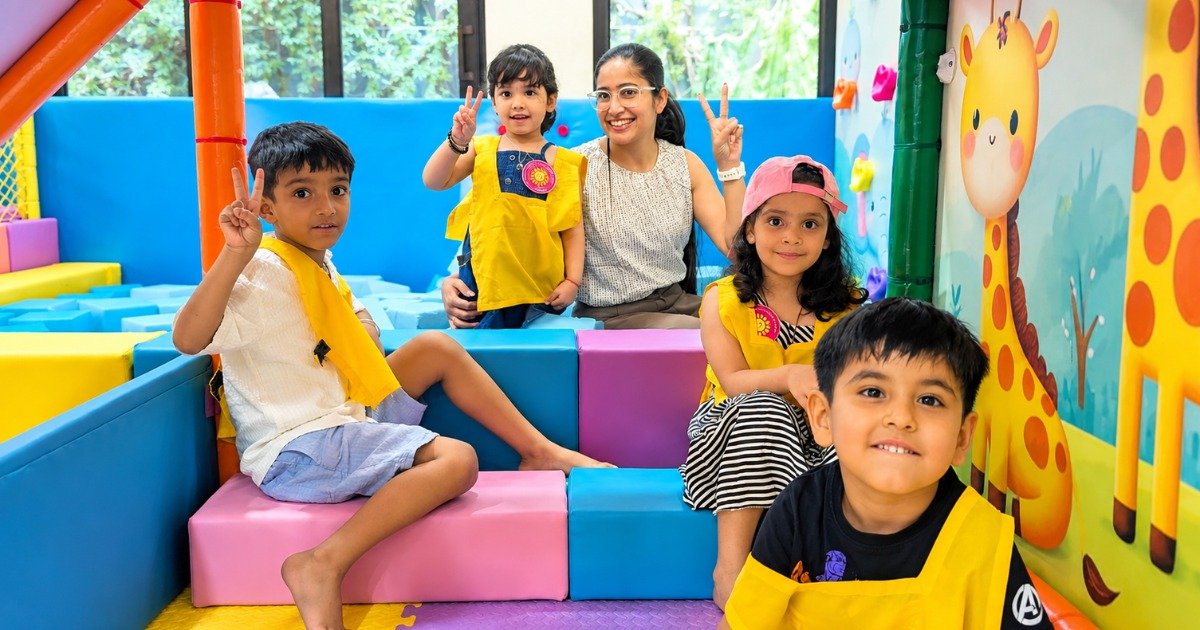
Photographs can help parents visualise the environment, but a current, guided campus visit is the best way to evaluate the actual learning space and observe how the school operates.
How to Compare a Play School in Kanpur
Many school search results look similar: safe environment, caring teachers, play-based curriculum and strong foundations. Those phrases are easy to repeat. What matters is whether a school can show you how its routines and decisions support real children. Use these five checks before you commit to an application.
1. The people and interactions
Notice whether children can approach adults comfortably. Ask how new learners are welcomed, how teachers handle difficult moments and how parents are informed about a child's day. A warm interaction is a stronger signal than a promise on a poster.
2. Real classroom experiences
Ask to see the actual learning spaces for the programme you are considering. Look for varied, age-appropriate activities, accessible materials and opportunities to move, speak and explore. Ask the teacher what children were investigating during a recent lesson.
3. Practical safety and daily routines
Ask who can collect a child, how visitors are managed, what happens if a parent is delayed, and how hygiene or emergencies are handled. Do not assume that mentioning CCTV or a security feature answers all these questions.
4. Communication with families
Understand how the school shares progress, discusses concerns and involves parents in supporting children. Ask how often you can speak with teachers and how adjustments are made when a child needs a different approach.
5. Travel and the real cost of attendance
For a young child, a manageable commute matters. Compare timings, arrival and departure routines, transport arrangements if offered and all current fee components. Always ask for a written, session-specific fee explanation rather than relying on a third-party listing.
Parents may also want to compare different schools without relying on a ranked list. Our Kanpur preschool comparison guide explains how to verify programme names, observe actual classrooms, ask about fees and care, and give each school the same fair evaluation. It includes links to original sources and does not claim any school is universally best.
Pandu Nagar: Visit the School, Not Just Its Website
Candy Floss is located in Pandu Nagar, near J.K. Temple in Kanpur. For families considering a play school near the neighbourhood, seeing the campus can help answer practical questions about access, classrooms, the journey and the atmosphere children encounter every day.
Online listings sometimes show different address formats and contact numbers. Rather than copying possibly outdated details, this guide points parents to the school's official contact page to confirm the entrance, current numbers and available appointment times. A school visit is also a chance to ask about the exact programme you are considering.
Preschool or Playschool: Do the Words Change the Choice?
Parents use 'preschool', 'pre school', 'playschool', 'play school' and 'nursery school' in overlapping ways. The spelling itself tells you little about classroom quality. Look at a school's published programme structure, starting age rules, daily experiences and transition into the next learning stage.
At Candy Floss, Playgroup, Lower Nursery, Nursery and Kindergarten have distinct learning objectives and classroom experiences. Use each programme page to explore those details. If your immediate question is whether your child can apply for the next academic session, go to the dedicated admissions resources rather than assuming a generic age chart is sufficient.
Admissions 2027–28: What Parents Should Confirm
Before applying, confirm the correct programme for your child, the approved age cut-off for 2027–28, the current registration dates, the complete fee structure and the document requirements. The school's general admissions and session-specific pages can help you begin, but written confirmation from the admissions office should govern final decisions.
If you are still comparing schools, book a visit first. If you already know the programme you want, use the official admissions enquiry route. Both paths should lead to a useful conversation with the school—not an assumption that every family needs the same next step.
Quick answers to real preschool decisions
Short, specific answers for families comparing programmes in Kanpur or moving from another Indian city. School-specific dates, availability and fees should always be confirmed directly.
What is the difference between a preschool and a play school in India?
In everyday searches, parents often use preschool, pre school, playschool and play school for similar early-childhood settings. The useful comparison is each school's actual age groups, daily learning experiences, adult-child interactions and admission rules—not the spelling.
My child is 2 years 8 months old. Should we choose Playgroup or Nursery?
Candy Floss currently describes Play Group for approximately ages 2–3, Lower Nursery for 3–4 and Nursery for 4–5. A child's age on the official 2027–28 cut-off date and the school’s entry policy must be confirmed before choosing a stage; do not promote a child based on age alone.
Is preschool compulsory before Class 1 everywhere in India?
The National Education Policy provides a curriculum vision for early learning and the Foundational Stage, but it is not a universal individual admissions decision. Families should check the applicable state and school requirements for their intended school and session.
Is Montessori the same as play-based learning?
No. Montessori refers to a particular educational approach, while play-based learning is a broader teaching concept. Do not assume a school uses a certified Montessori methodology without asking the school for its actual curriculum and teacher preparation.
Does the National Curriculum Framework say children aged three must join this particular preschool?
No. The national framework explains curricular development for the Foundational Stage (ages 3–8); it does not mandate admission to Candy Floss, fix its session-specific fees or certify individual classrooms.
Where can parents from another city find current Candy Floss admission details?
Use the school's official admissions page and confirm cut-offs, dates, fees and documentation directly with the school. A family relocating from Delhi, Mumbai, Lucknow or another city should not assume previous school-stage names translate exactly.
How can I find a play school near me in Kanpur?
Start with the real location of the school, not the phrase ‘near me’ alone. Candy Floss Preschool is in Pandu Nagar, near J.K. Temple, Kanpur. Compare your actual journey, the available programmes and the classroom experience; ask the school to confirm the correct entrance and visit availability.
Will ‘preschool near me’ show the same results to every parent?
No. Nearby school results depend partly on the searcher’s location, so families in different Kanpur neighbourhoods may see different schools. Check the school’s verified location, travel time, programmes and official contact details before deciding.
How do parents check preschool age eligibility for the 2027–28 session?
Use the child’s date of birth and the school’s official session-specific cut-off date. Candy Floss publishes broad age bands for Play Group, Lower Nursery, Nursery and Kindergarten, but the published bands do not establish the final 2027–28 admission criteria.
Frequently Asked Questions from Kanpur Parents
What age should a child start play school?
The appropriate starting point depends on the child, the programme and its current admission rules. Candy Floss's existing published overview groups Playgroup at 2–3 years and other stages progressively, but parents must confirm the applicable 2027–28 cut-off date and eligibility.
How can I tell whether my child is ready to join a group?
Look at communication, comfort with a new environment and practical care needs rather than expecting academic preparation. Discuss any separation anxiety or additional support needs with the admissions team. Children adjust at different paces.
Should I choose a preschool near home?
A manageable commute can reduce stress, but proximity alone is not enough. Balance location with teacher interaction, suitable learning experiences, safety routines, family communication and your child's response to the environment.
Are Playgroup, Lower Nursery and Nursery the same?
No. Candy Floss describes them as separate stages with changing learning goals and activities. Names and age rules vary across providers, so compare actual programme details and current admission criteria.
Can I see the classrooms before applying?
Ask Candy Floss about authorised school-visit appointments. During a visit, observe the relevant programme's learning spaces and use the parent checklist to ask questions about the day-to-day experience.
Where can I get confirmed fees and registration dates?
Use the current official admissions process and contact the school for written session-specific information. Online directory prices and older annual schedules may be out of date.